
| Designer | Pier Luigi Marconi | Premiere | Cologne 1994 |
| Production period | 1995 – 1996 | Production numbers | 376 |
| Power | 36 KW (48 PS) | Displacement | 652 cc |
| Topspeed | 196 km/h | Weight | wet 160 kg dry 145 kg |
| Price | 20.150 DM (1995) | Colours | red / silver |
| Technical basis | BMW F 650 |
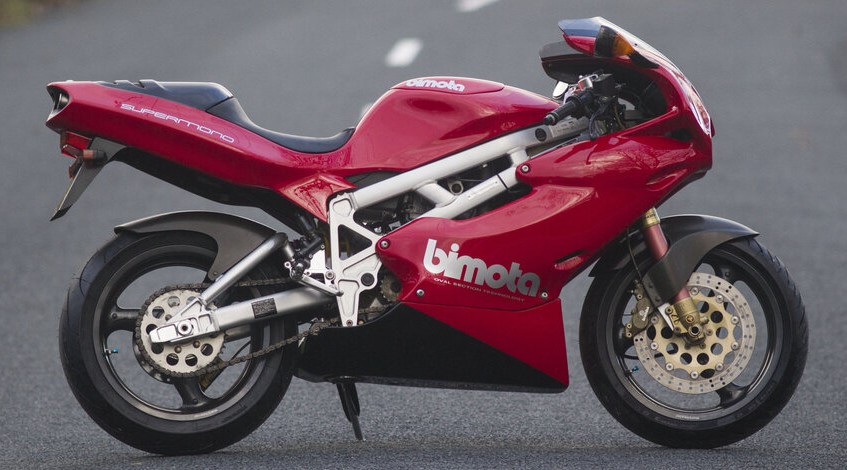
The BB1, alongside the simultaneously introduced DB3 Mantra, is one of the few Bimota models that deviates from the brand’s usual high-performance lineup. Equipped with the single-cylinder engine from the BMW F 650 and producing a modest 48 hp by Bimota standards, its specifications differ significantly from the company’s typical high-performance sportbikes. However, the BB1 offers exceptional handling characteristics thanks to its radical chassis geometry and lightweight construction. The German motorcycle magazine MO summarized its qualities in issue 5/1995:
„A 1,340 mm wheelbase, a 69-degree rake angle, and 78 mm of trail – figures more reminiscent of a trail bike… Perfect suspension components, clever weight distribution, and, most importantly, supple radial tires with a large contact patch ensure outstanding stability. As a result, Bimota’s Supersingle delivers handling that allows you to change your line at will, even in a fully committed 100 km/h corner, while remaining precise and stable at full throttle in fifth gear.“
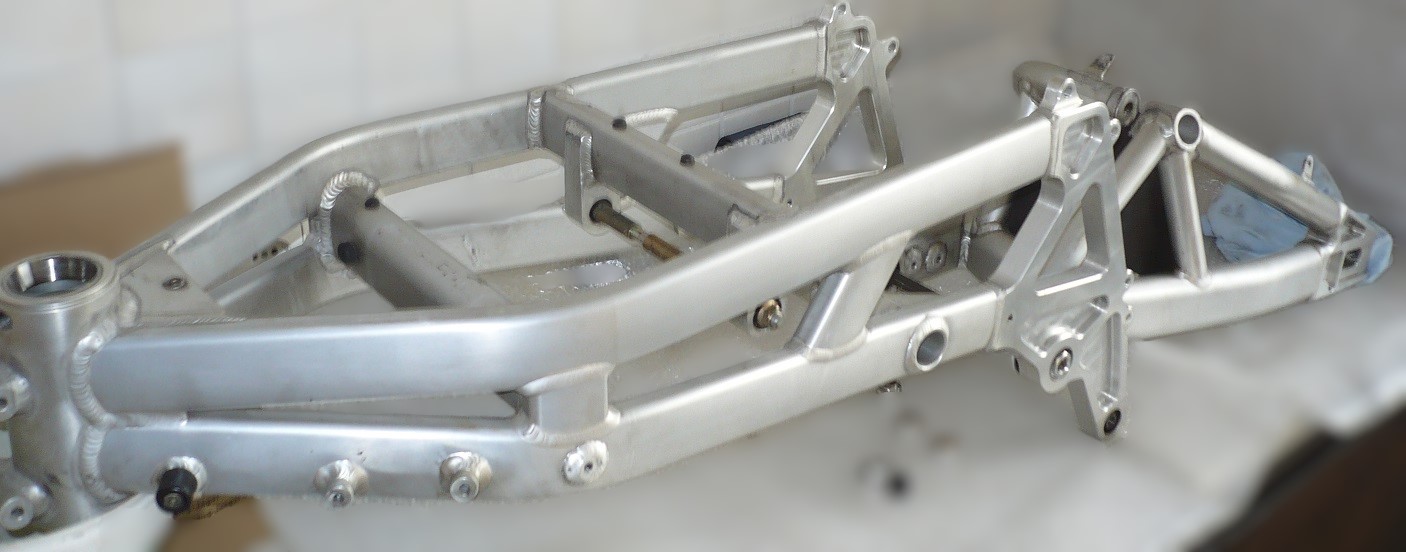
Like the DB3, the BB1 features an aluminum bridge frame made from oval tubing. However, in the swingarm pivot area, it is reinforced with solid milled plates that are welded in place. The aluminum swingarm itself is constructed from a combination of oval and round tubes.
Reflecting its modest power output, Bimota equipped the BB1 with a single 320 mm front brake disc paired with a four-piston Brembo Gold Series caliper, while the rear features a 230 mm disc.
One of the BB1’s most innovative technical features, only noticeable upon closer inspection, is its 16-liter fuel tank. Instead of the conventional placement, the tank is mounted below the engine and shaped as part of the lower fairing. This design lowers the bike’s center of gravity, significantly improving handling. As a result, space beneath the monocoque is freed up for the electrical components and a small storage compartment. The fuel filler cap is positioned on the left side, integrated into the fairing just above the radiator.
A distinctive design element is the set of mirrors with integrated turn signals—an idea previously seen on the futuristic Gilera CX 125, introduced in 1991.
Technical specifications and measurements from mo Motorrad Magazin, Issue 5/1995:
Engine:
– Liquid-cooled, single-cylinder, four-stroke inline engine, mounted transversely
– Bore x stroke: 100 x 83 mm
– Four valves per cylinder, dual overhead camshafts (DOHC)
– Valve actuation via bucket tappets
– Displacement: 652 cc
– Compression ratio: 9.5:1
– Rated power: 35 kW (48 hp) at 6,500 rpm
– Maximum torque: 60 Nm at 6,000 rpm
– Two Mikuni constant-vacuum carburettors, 33 mm diameter
– Contactless digital ignition
– Cable-operated multi-plate wet clutch
– Five-speed gearbox with dog engagement
– Dry-sump lubrication with plastic oil tank located in the frame’s steering head triangle
– Final drive via 520 O-ring chain
– Electric starter
Chassis:
– Lightweight aluminium oval-tube twin-spar frame
– Paioli telescopic front forks, 43 mm stanchion diameter
– Adjustable rebound damping
– Aluminium swingarm with directly mounted Paioli rear shock absorber
– Adjustable rebound and compression damping, spring preload and shock absorber length
– Wheelbase: 1,340 mm
– Rake angle: 69 degrees
– Trail: 78 mm
– 320 mm front disc brake with four-piston fixed caliper
– 230 mm rear disc brake with fixed caliper
– Tyres: 160/60 ZR 17 rear, 120/70 ZR 17 front
– Anterra cast aluminium wheels, 5.00 x 17 rear, 3.50 x 17 front
Dimensions and weights:
– Length: 1,990 mm
– Seat height: 790 mm
– Dry weight: 145 kg
– Kerb weight: 160 kg
– Fuel tank capacity: 16 litres